

Ready to enhance your climate teaching through video production? Join us in creating impactful, solutions-focused climate stories through engaging videos that boost your influence in the classroom and beyond!
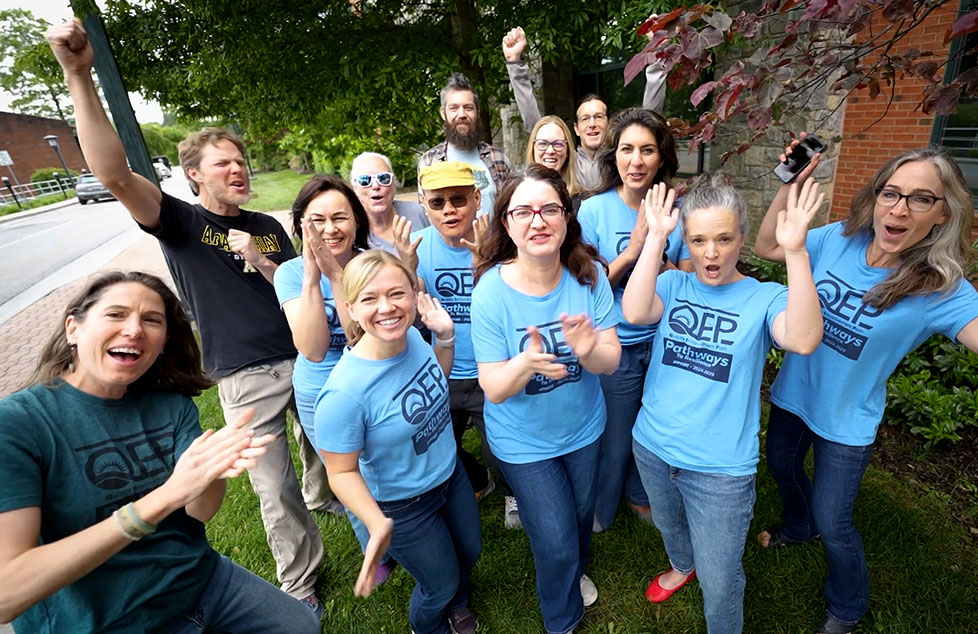
The Pathways to Resilience Quality Enhancement Plan (QEP) invites faculty from across campus to participate in our second Climate Solutions Video Institute.
This five-day institute aims to inspire creative storytelling for climate solutions along with fostering a community of faculty ready to cultivate their creative and technical skills in harnessing the power of video production for teaching and learning. Participants will receive a stipend and are expected to submit a completed short video (target length 8-10 minutes) by the end of the institute.
Apply by March 20, 2026 (details below) to be considered! This Institute is limited to ten faculty participants; participants from the 2025 Climate Solutions Video Institute are welcome to apply again!
Goals: The primary goal of this institute is to provide university professors (TT and NTT) with the skills to create short, compelling videos on climate solutions related to their area(s) of expertise. Professors will learn how to craft engaging video stories, handle selected technical and aesthetic aspects of video production, and integrate video into their teaching practices. A secondary goal is to support the longevity of the Climate Responses and Response-Ability courses Videos produced during the institute may be integrated into a faculty member’s upper-level courses within their own academic programs and/or selected by other faculty involved in teaching the campus-wide Climate Response-Ability courses.
Instructors (bios below): This institute will be facilitated by Dr. John Henson (Department of Media, Career Studies, and Leadership Development), Kevin Gamble (Department of Sustainable Technology and the Built Environment), and Dr. Theresa Redmond.
$1500 Stipend: This Institute is a compensated professional development program offered to instructors (TT and NTT) who are willing to commit to the five-day learning experience and complete a short video for use in their own teaching and in the Climate Responses and Response-Ability courses.
Time Commitment: Participants can expect the following, including a combination of learning activities, editing time, and solo work:
- Pre-work (April–May 2026): Working independently in a location of your choosing, you’ll join a one‑hour welcome meeting via Zoom (date TBD), complete the 6-hour LinkedIn Learning course titled Premiere Pro 2025 Essential Training, and install Adobe Creative Cloud with Adobe Premiere Pro 2026 on your university‑issued laptop.
- Monday, May 11, 2026 9am-2pm: in-person program
- Tuesday, May 12, 2026 9am-2pm: in-person program
- Wednesday, May 13, 2026: 9am-2pm: in-person program
- Thursday, May 14, 2026: 9am-2pm: in-person program
- Friday, May 15, 2026: 9am-2pm: in-person program
Application: Please complete this Climate Solutions Video Institute Application Form by Friday, March 20, 2026. Applicants will be notified by Friday, April 3, 2026.
Questions: Contact Laura England (englandle@appstate.edu)
Instructor Bios
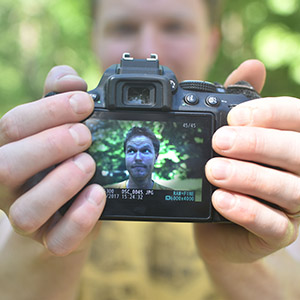
Dr. John Henson brings a background in professional photography, video production, technology integration, and curriculum design to his work as a Teaching Associate Professor in the Media, Technology, and Learning Design Program at Appalachian State. He teaches people to tell stories with both emerging and traditional forms of media; from designing video games and exploring virtual and augmented reality, to planning photo shoots and crafting fictional and documentary videos. John grew up in the mountains of western North Carolina, earning his B.S. in Commercial Photography and Ed.D. in Educational Leadership at Appalachian State University. He earned his M.A. in Educational Media and Technology at Boston University. Through teaching media studies, John’s goal is to empower and inspire new generations of learners to creatively tell the stories that matter to them and their communities.

Dr. Theresa Redmond is an independent scholar, teacher, and artist with recognized expertise in media literacy, instructional technology, curriculum design, ecomedia literacy, and the arts. She has taught early elementary school through university students, published widely on innovative methods in teaching and learning, and received awards for teaching, service, and creative scholarship. With over 20 years in public education, Theresa brings a deep and versatile experience to her work building curriculum, developing programs, leading teams, and consulting on projects at the intersection of learning, creativity, technology, and society.
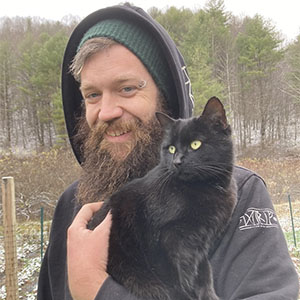
Kevin Gamble is a Senior Lecturer in the Renewable Energy Technology program, where he focuses largely on the intersection of society, the environment, climate, and technological development, as well as sustainable strategies for waste reduction and treatment. Kevin earned his BA in Religious Studies and his MS in Appropriate Technology at Appalachian State University and is currently working on an MA in History. Kevin has taught at App for the last twelve years, earning the CFAA Outstanding Teaching Award in 2024. When not teaching, Kevin can be found working on his solar-powered farmstead, Lucky Gamble Farm, with his wife, two dogs, and barn kitty, where they raise geese and chickens and focus on expanding their berry orchard. Kevin also operates a small-time compost consulting and education business: Wildcat Compost. Kevin was a participant in the inaugural QEP Climate Solutions Video Institute and enjoyed it so much he’s returning for more! He brings both a passion for climate communication and a creative approach to climate storytelling.